
Criminal Cases in the Dallas County Courts
Dallas County belongs to Missouri's 30th Judicial Circuit. The Circuit Court tries felony cases, while its Associate Circuit divisions hear misdemeanors, traffic cases, and early felony proceedings such as preliminary matters. Municipal ordinance and traffic cases begin in the appropriate city judicial channel. They may not display the same history or detail as a state criminal case. The filing court shown on the docket is therefore a core part of every search.
The Dallas County Circuit Clerk is the custodian of state criminal case files. The clerk maintains the docket, pleadings, court orders, judgments, and certified copies. Police narratives and jail booking sheets remain with the agency that made or recorded the arrest. This division matters because a filed charge can differ from an intake charge. For court status, use the prosecutor-filed charge and the court's final disposition.
Dallas County Circuit Criminal Jurisdiction
A single Circuit Court framework handles state criminal litigation in Dallas County, yet the division hearing a matter reveals its procedural stage. A felony may begin with a complaint and preliminary hearing before moving toward an information or indictment, arraignment, motions, plea, or trial. A misdemeanor may remain in Associate Circuit Court. The 30th Judicial Circuit local rules apply across Dallas, Hickory, Polk, and Webster counties, but the Dallas County Circuit Clerk keeps the local file.
City matters need a second check. Buffalo ordinance cases and other municipal matters may be publicly indexed through Case.net, but the active division and record custodian should be confirmed with the city or clerk. A county name search alone can also produce similarly named parties in other courts. Verify the location, case number, filing date, and charge before treating a result as the intended Dallas County criminal case.
The courthouse is the local point of record even though the circuit spans four counties. A hearing notice that cites the 30th Judicial Circuit does not shift a Dallas County file to another county's clerk. Read the location line and court division on each result, especially when a person has cases in more than one circuit county.
How to Search Case Records
Missouri Case.net is the first remote channel for public Dallas County court dockets. It can locate current and older electronic case entries, but it does not promise a downloadable image for every filed document. Use exact identifiers for a Dallas County criminal case when available, then ask the Circuit Clerk for certified, archived, or courthouse-only material.
- Open Case.net, review the notice, and accept its terms.
- Choose Litigant Name when the case number is unknown. Add the first and middle name to narrow common-name results.
- Limit the court or location to Dallas County and select a criminal or traffic case type when that option appears.
- Open a likely match and compare its case number, filing date, charge, court, docket events, and disposition.
- Contact the Dallas County Circuit Clerk when a document image is absent or an official certified copy is required.
Searching Dallas County Cases in Case.net
Case.net separates its searches by task. Litigant Name works best for an unknown number, while Case Number is the precise route once a citation, pleading, or prior docket supplies it. Filing Date, scheduled hearings, and the judgment index answer narrower questions. Dallas County search results should be treated as candidate matches until the case header and charge context align.
| Field Label | Type | Required | Options or Notes |
|---|---|---|---|
| Search type | Navigation tabs | Yes | Litigant Name, Filing Date, Case Number, Hearings, or Judgment Index |
| Last Name | Text | By name tab | Surname or business name |
| First and Middle Name | Text | No | Useful for separating similar names |
| Case Type | Dropdown | No | Choose criminal or traffic when offered |
| Court or County | Dropdown | No | Dallas County or the 30th Judicial Circuit |
| Case Number | Text | By number tab | Enter the exact court number |
| Filing Date | Date range | By date tab | Use the interface format |
A case event can be visible when its document is not. That does not make the event incomplete. It means remote public access stops at the docket entry and the clerk must handle the next step.
What the Case File Shows
The Dallas County court file traces allegations as they were formally filed and resolved. Its case header identifies the court, status, and filing date. Charge rows show the offense, statute, level, alleged date, and outcome. The docket then records procedural events in order. Public financial entries may show costs, fines, payments, and balances, while judgment fields identify the plea or finding and the sentence imposed.
| Case Number & Court | The unique case identifier, Dallas County location, case type, filing date, judge, and status. |
|---|---|
| Parties & Counsel | The State of Missouri, named defendant, and attorneys appearing in the case. |
| Charging Record | Count sequence, offense description, statute, felony or misdemeanor level, alleged date, and disposition. |
| Docket Entries | Filings, service or warrant activity, hearings, motions, pleas, judgment, sentencing, and compliance events. |
| Hearings | Event type, scheduled date and time, location, and judicial officer where public. |
| Judgment & Sentence | The plea or finding, SIS, SES, or executed sentence, plus jail, prison, or probation terms. |
| Documents & Redactions | Authorized document links; protected identifiers, victim or minor information, and sealed content are omitted. |
Older Dallas County Criminal Files
Case.net is not the only route for historic Dallas County case research. The Circuit Clerk can identify locally retained volumes, while the Missouri State Archives Dallas County inventory lists surviving circuit criminal records and indices on microfilm. Begin with an approximate year, the court, and every known spelling of the party's name. Newspapers or family papers may help identify a term or volume before a clerk search.
A hard Dallas County archival limit applies. Courthouse and record fires occurred in 1863, 1864, and 1867. The 1867 destruction reportedly eliminated county records, including indictment material. When the cited volume did not survive, repeated spelling variations cannot recover the lost file. Ask whether an index or microfilm volume exists, and treat a documented gap as a preservation issue rather than a failed online search.
The source image from the Missouri Courts forms catalog shows the official judiciary channel used for approved pleadings and court forms.
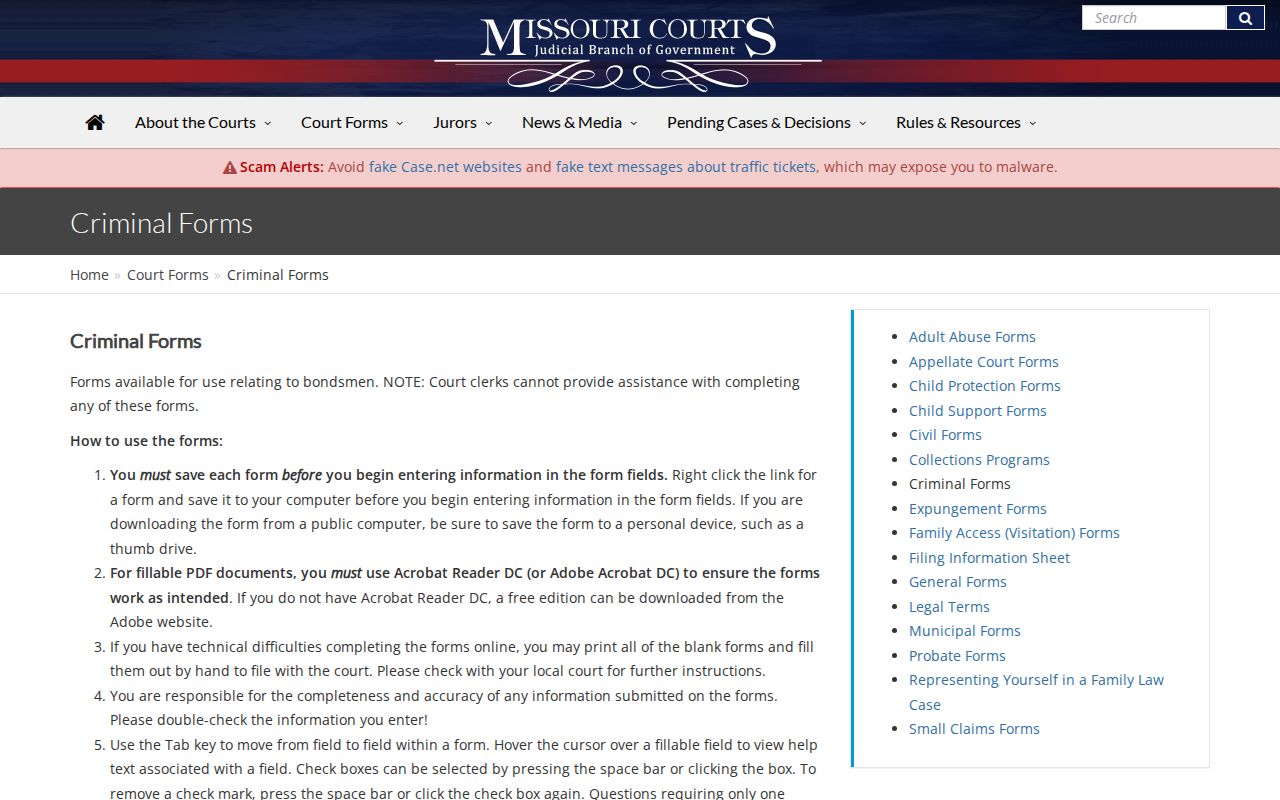
That statewide catalog supports current filings, while the Dallas County clerk and State Archives remain the better contacts for an old criminal case file.
Stages of a Criminal Case
A Dallas County criminal docket can begin after an arrest or a summons. The early record may contain a probable-cause finding, initial appearance, complaint, and bond action. A felony can move through a preliminary hearing or grand-jury indictment before arraignment. Discovery, motions, and hearing settings follow. The case may end through a negotiated plea, trial, dismissal, or acquittal, with sentencing and later appeal or post-conviction activity where applicable.
Case flow: Charges Filed › Arraignment › Pretrial › Plea or Trial › Disposition › Sentencing
The Dallas County sequence explains why a jail booking and court docket can disagree. Booking charges describe intake. The prosecuting attorney decides what to file, and the judgment controls what was ultimately adjudicated.
Dallas County Criminal Dispositions
Missouri docket terms carry distinct results in a Dallas County case. A disposition is the outcome of a count or case. A nolle prosequi means the prosecutor formally chose not to continue that charge at that time. Dismissal and acquittal also end a charge without a conviction, but through different procedural events. A plea entry is not the sentence itself, so continue through judgment and sentencing rows.
- SIS
- A suspended imposition of sentence withholds sentence while probation is completed. The record generally closes after successful completion.
- SES
- A suspended execution of sentence imposes a sentence but suspends its execution during probation. It includes a conviction judgment.
- Executed sentence
- The court orders the imposed jail or prison sentence to be carried out.
- Disposition
- The recorded outcome for a charge, such as conviction, dismissal, acquittal, or nolle prosequi.
These distinctions affect public visibility. Under RSMo §610.105, specified non-conviction outcomes and a successfully completed SIS become closed subject to the law's terms. An SES should not be read as an SIS merely because both involve probation.
Access & Restrictions
Missouri court records are public unless a law, court order, or operating rule restricts access. Court Operating Rule 2 guidance governs judiciary access and confidentiality. The public Case.net view omits Social Security numbers, dates of birth or similar confidential identifiers, protected victim and minor information, sealed material, and files closed by law. A document event may remain visible even when its image is not available remotely.
Closed does not mean destroyed. RSMo §610.120 generally blocks public access to closed records while allowing the listed statutory access. Expungement under §610.140 is a separate court remedy. When a known Dallas County case is missing, give the Dallas County clerk the case number, approximate filing date, party spelling, and court division. The clerk can determine whether the cause is an archive, a remote-access limit, a closure rule, or an incorrect search term.
Certified Dallas County Criminal Copies
A Case.net printout is a useful working reference, but it is not a clerk-certified record. The Dallas County Circuit Clerk issues certified copies and can address archived pleadings or public document images that are not downloadable. Contact Susan Faulkner's office at 417-345-2243 or susan.faulkner@courts.mo.gov. Mail goes to P.O. Box 1910, Buffalo, Missouri 65622. Call before visiting to confirm counter access and the cost for the exact copy requested.
Dallas County Circuit Clerk
P.O. Box 1910
Buffalo, MO 65622
417-345-2243
Fax: 417-345-5539
susan.faulkner@courts.mo.gov
Describe the Dallas County record precisely: case number, filing court, party name, document title, and whether certification is required. A request for the judgment and sentence is narrower than a request for the entire file and helps the clerk identify the intended public record. For broader Dallas County records, the county criminal history overview explains which custodian holds each record type.